Saturday, March 17, 2012
Happy St. Patrick's Day!
Monday, October 31, 2011
Snapshot moments
As I'm reading my students' reflections on this essay, I am reminded of my own "snapshot moments"--those moments when time seems to slow down and the details of the day come into clear focus. All of them, by the way, have happened when I'm out of the house. So, for me, I need to be out, among people, watching and seeing what's happening.
The first was early this past summer, maybe in May or early June. I was on a bicycle ride, and passed a house where a mom and her toddler were on their driveway. She was just an average mom, and he was just an average little boy. But the moment was very poignant to me. The sunlight angled onto their driveway in late afternoon. The mom, with a bubble wand, began to slowly turn in a circle, letting the bubbles seep into the air. The boy hopped up to catch the bubbles. I could almost hear the plink of the popping bubbles, though I was not near enough. It was the essence of a perfect summer moment.
Then today, as I drove home, like a movie, I saw another scene that reminded me of my snapshot moments. This time, a boy with a black mask and a blue cape ran across the street, cape billowing behind him in the afternoon crispness. Behind him, his friend, a pirate in a maroon coat and triangle hat, hung on the stop sign, spinning in circles. The scent of fallen leaves gathering on the dewy lawn trickled in through my window. And again, the moment seemed like a perfect snapshot of the season.
Goldberg reminds us to turn off our "thinking minds" and wake up--watch the caterpillar scooting across the sidewalk. Listen to the clink and hiss of the espresso maker at the coffee shop. Breathe in the scents of the seasons. Enjoy!
Tuesday, July 12, 2011
A few thoughts on writing
I've been reading a book called "Through a Dog's Eyes" by Jennifer Arnold. In the section I read last night, she discussed body language of dogs and how the curve of their lips, the base of their tail, and the position of their torso communicates a great deal. They primarily communicate through body language.
But people are different. We certainly use body language, and as our technology advances, I am even more convinced that personal communication is vital to a relationship. We miss so much when we email, IM, or even when we talk without the benefit of seeing the other person's facial expressions, tone, and body language. This is one reason why I find it a challenge to teach online.
However, unlike dogs, we use words. Words mean things. Words communicate so much more than our body language can.
Saturday, January 29, 2011
Movie review: Social Network
On a fall night in 2003, Harvard undergrad and computer programming genius Mark Zuckerberg sits down at his computer and heatedly begins working on a new idea. In a fury of blogging and programming, what begins in his dorm room soon becomes a global social network and a revolution in communication. A mere six years and 500 million friends later, Mark Zuckerberg is the youngest billionaire in history... but for this entrepreneur, success leads to both personal and legal complications. Written by Columbia Pictures
Here's the link to the official movie website. Basically, the story is a legal battle over the intellectual property of Facebook, interwoven with the back story of the creation of Facebook. It's an interesting movie that caused me to think about several take-aways.
1. The creative process is messy. The legal battle deals with who came up with the original idea of Facebook, as a product. If the plot of the movie is true-to-life, then just how Mark Zuckerberg came up with the idea of Facebook was truly a conglomeration of many ideas he was exposed to or dreamed up himself. I think this is why writers are sometimes skittish when it comes to working in a critique group when sharing original, unpublished ideas. The creative process feeds off of many ideas, and then we often assimilate all of those various experiences and thoughts into something new.
2. Facebook is no replacement of real, human relationships. As a matter of fact, as I've learned through bitter experience, Facebook can sometimes magnify hurts and brokenness between people. Or, on a positive note, it can pave the way for a deeper friendship. *SPOILER ALERT* The saddest scene in the movie is at the very end when Zuckerberg, a successful business person and creative genius, is sitting there awaiting friend confirmation from his old girlfriend. *SPOILER ALERT END* The bottom line is that there's just no substitute for real, face-to-face talking between people that helps bridge some of the loneliness everyone experiences.
3. Creativity can be a curse. Again, if the story is true-to-life, then Zuckerberg, like other creative geniuses live desperate, lonely, difficult lives. Think of Van Gogh, Keats, Faulkner, Hemingway, and many others who either suffered from mental illness or social awkwardness and alienation.
It was a thought-provoking movie that definitely provides commentary on our time. I recommend it.
If, by the way, you want to "like" Mark Zuckerberg, you can find him here on Facebook.
Thursday, January 27, 2011
Writing Spaces
I've posted photos of my sunroom before, but here is another shot--not in the dead of winter! I'm finding this is more of a 3-seasons room because lately I am longing for the hibernating feel of our warmer family room and my corner on the couch with my laptop. The sunroom is part of an addition to our house that isn't attached to the heating and cooling system of the house. Between the bleakness of the gray and white backdrop of the cold, snowy backyard and the cold temps, I am not working in there as much as in the warmer months.
The Rt. 19 Writers have a nice series on how they work in Pittsburgh. Check it out.
Tuesday, January 11, 2011
Picture books go high-tech...some thoughts
Yes, the economy and possibly the rise of iPads and Nooks capturing that interactive, cool, technologically advanced version of books has led to fewer picture books being printed. But they're still around and publishers are still buying new manuscripts.
So here are my random thoughts on this issue that could affect reading for kids and parents. An article from the New York Times features the color Nook's e-reader.
Recently, I was able to view a children's book on my friend's Nook. It was cool. The colors were vibrant and the story still endearing. I also had a chance to look at the interactive elements of a children's book on an iPad.
As a mom, I wonder how many parents would feel about their little ones handling their expensive equipment, like an iPad. I get nervous when my 15-year-old needs to borrow my laptop (yes, I am a bit paranoid, but he also has a habit of dropping things, stepping on earphones, etc.), so how much more would I feel anxious about a preschooler with sticky fingers and a drippy nose handling my iPad? It's one thought that comes to mind. However, the interactive nature of the illustrations and text is very cool. I would definitely sit there and play around with the ticking clock or read-aloud text, and I could see parents really enjoying sharing these resources with their kids.
The other thought I have about e-Readers comes from my experience in reading a recent book for adults on my husband's Kindle, the e-Reader produced by Amazon. At first, I felt totally out of my element. I was pushing buttons on this foreign contraption and just couldn't get used to the fact that I was reading an actual book. As I got into the story, it became more natural. I liked the fact that I could adjust the font size easily, but I guess that normally I must do a lot of flipping around when I read a paper book. I read the info about the author, I flip ahead to see how long the chapter is, I look at the chapter headings. This is not so easy with an e-Reader.
But, on the pro side of the argument, you no longer need bookmarks.
An editor recently told me about a children's book called "It's a Book" by Lane Smith. Love it, love it, love it! One character is reading an actual paper book, and an annoying, slightly ignorant character keeps asking what it is. What does it do? Where's the plug? It's a great story, with a bit of commentary on our cultural obsession with gadgets.
So, I guess the bottom line for me is that I don't think picture books in their traditional form will be going away any time soon. There's still a physical connection we have with stories and with page turns and the story--literally--unfolds. But I also love technology and have my own love of gadgets, so I can see parents embracing this new "delivery system" of books as well. My husband, who has owned a Kindle for a couple of years, uses it occasionally, and also reads regular books. Not all books are available on the Kindle, and he still goes to the library to check out books as well. This is what I picture parents doing. They may have a couple of books on their iPads to share with their kids, but will also make those library and bookstore runs for books as well. As an author, I think the possibilities are exciting, and I hope someday to see one of my books on an iPad or Nook!
Monday, January 10, 2011
The Writer's Work: Not Lonely!
I don't know if I'm a typical writer. Most likely not. I write for kids (for the most part), so the stereotype of the frustrated, caffeinated, tobaccoed writer doesn't really fit--at least it doesn't fit me.
But the lonely, isolated part? That definitely isn't me. Yes, I do spend time alone and enjoy it. I need room to think, and quiet in which to think it. But one of the best thing about writers is our community. We need each other. We need advice, moral support, critiquing, and lots of it.
So, I'm excited that tomorrow I'm getting together with a group of children's writers in my area for a critique group. We plan on meeting regularly to critique each other's work, and tomorrow is our launching party. In what ways has the writing community helped other authors?
Saturday, January 08, 2011
The Writing Life
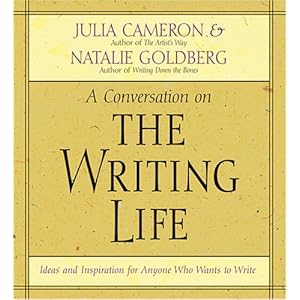
Julia Cameron is one of my favorite writing inspirations. She is probably most famous for The Artist's Way or its follow-up Vein of Gold. But I love her book The Right to Write. She considers herself an artist and doesn't allow herself to be pigeon-holed as a writer or screenwriter or poet or musician. But I find that her book on writing is the most helpful and has the closest correlation to what I need.
She speaks a great deal about morning pages--three pages in long hand written every morning. This is a writing practice which gets you in the process of writing so that when you have time to sit down and work on your projects, you are not overly concerned about the marketability of the work. You just write. It's the way to get the "censor off your shoulder." While I'm not completely successful at this, I do try to stick to a writing regimen in that I write in my journal at least several times a week. This is writing just for me, not to sell, not to share. It keeps me connected to the page.
Natalie Goldberg is most well-known for her book Writing Down the Bones, another book on writing and the writing life. I'm not as familiar with her work, but I know many other writers who love it.
This audio CD is a conversation between these two authors and a moderator. In the first part, the three sit down and talk in a studio, and in the second part, they discuss writing in front of a studio audience. It's a highly motivational and inspirational CD that I recommend to any writer, wherever they are in their writing journey--whether published or not. Check it out!
Friday, December 31, 2010
Plotting and Structure
I've read some great books over the years on this very topic, including my favorite (modestly titled): How to Write a Children's Picture Book by Eve Heidi Bine-Stock. In this book, Bine-Stock describes the necessity of looking at pacing and the "beats" a repeated phrase or refrain can lend to a book. She does so by examining classic picture books, like The Carrot Seed by Ruth Krauss and Bill Martin Jr.'s Chicka Chicka Boom Boom and shows how they work effectively through their structure.
For example, each story is expressed in what she calls acts, like in the acts of a play. A "three-act book" would work in this way:
Act 1 - Introduce character and conflict
Act 2 - Show developing conflict, leading to its ultimate climax
Act 3 - Quick denoument, resolving the conflict
The great thing is that any story can easily fit into this format. Even a saga like Tolkein's Lord of the Rings could be broken down in this way:
Act 1: Introduction of Frodo, the ring, the conflict--the great need to destroy it
Act 2: The journey of getting to Mount Doom to destroy the ring, rising to the climax of its destruction
Act 3: The restoration of Middle Earth, the coronation of the king, the departure of Frodo
Of course, in this trilogy, Act 2 comprises most of the text, with mini stories (with beginnings, middles, and endings) throughout the rising action. For example, their journey through the Mines of Moria is a mini story, within the larger plot of the book.
All of this is in the back of my mind because I am currently working on a project with a very short word count, which would be a young picture book. I imagine this targeting the 2-4 year old range. The stories focus on a toddler who begins to learn how to solve his own problems. What is so much fun for me is to see how short they can be, while still preserving that natural story arc. I'm striving for no more than 400 words total, and telling three little stories in which each one has its own beginning, middle, and ending, with the character figuring out how to solve his own problems. It's been a fun and challenging project, which is almost ready for submission.
Friday, August 07, 2009
Adorable readers...
Sunday, April 19, 2009
Field Day Fun
Water Balloon Volleyball
The net is up. The teams are poised,
the water bombs are set.
Anne Marie steps up to serve.
She eyes the sagging net.
The bomb is launched, away it flies,
but gets there with a splash.
The bomb explodes in Richie's hands,
which starts the water bash.
A splash on us. A splash on them,
oh, who will win this game?
Balloons are raining everywhere--
be careful when you aim!
The game goes on. It's getting hot.
Our server tries again.
More points for us. More points for them.
The score is ten to ten.
We're low on bombs. We're getting soaked.
I hope the game's done soon.
Then comes the call: "Game point!" we hear.
It's getting close to noon.
The final bomb then heads our way,
but doesn't clear the net.
And even thought we win the game,
we most liked getting wet.
Saturday, April 11, 2009
How things come together
June 19, 2001, Touchdown
In the flat plains
north of Denver,
our plane bumps
onto the runway
in midafternoon sun.
Suddenly, I am in 1880,
a settler
in the red dirt.
My hair, in a bun,
my dress,
long as Sunday,
my hands,
rough and calloused.
I shield my eyes from the sun
as I look for my man
through dusty wind,
waiting for gold,
settling for flour
to feed my family.
A memory engulfs me:
the claustrophobia
of trees,
leaves,
bushes,
ivy,
grass
of western Pennsylvania,
crowding thick upon me.
But now I open my eyes,
stretch out my
lungs,
wide as miles,
and
breathe.
Friday, March 27, 2009
Gobble Gobble Crash and Poetry
By the way (did I post this already? I can't remember), I found out recently that Gobble was chosen as the Feb. 09 book of the month for Dolly Parton's Imagination Library. Thank you to that organization for choosing Gobble. I love that it's going to lots of children's homes across the country. I've had such fun with this turkey story, and I'm thrilled to share it with young readers and their families. Dolly's program, Imagination Library, is a great one, providing free books once a month for children under 5.
Saturday, March 14, 2009
Encouraging Literacy in the Very Young, Part 4
But it's hardly the story I recall. What I remember is feeling the utter and complete joy that a child can feel when sharing a good story with someone they treasure.
My grandfather died not too long after that, when I was only nine, so my memories of him are very few. But this is one I hold onto. My grandfather was not a well-read man. He was a carpenter. He worked for most of his life making cabinets and tables and chairs. His garage smelled of sawdust. The tools were lined up on the walls, just so. What I remember, though, and what I treasure most is that he read with me.
Tuesday, March 10, 2009
Encouraging Literacy in the Very Young, Part 3
Allow your toddler time to feel the cool dampness of mud, the tickly grass, the sounds of honking geese. Then…guess what comes next…read about what your child is naturally drawn to. Find books about mud, grass, and geese. Get fiction and nonfiction. If a thunderstorm rumbles through town, talk about it with your child, and then go get some books on lightning and thunder. The great thing about children's books is that you can find a book on a certain topic for any age.
For example, when I share my book Cheep! Cheep! with preschoolers or young grade-school children, I often show them other books (not necessarily mine) that have similar themes. Cheep! could lead to several different thematic ideas:
- a new sibling joining the family - read Cheep as well as books like Mercer Mayer's The New Baby
- other farm animals - look at Garth Williams' Baby Farm Animals or Margaret Wise Brown's Big Red Barn
- welcoming spring - look at a book by Lois Ehlert, like Planting a Rainbow
For an reader (adult or child), the key is finding what you like to read about--baseball, solar eclipses, giant squid, flea markets, or yes, possibly, even baby chickens. Whatever you like--enjoy!
Monday, March 09, 2009
Encouraging Literacy in the Very Young, Part 2
Tip #2 - Get books into the hands of children.
So, after setting aside one or more reading times per day for your little one, now you need to have books to read. What are the best places to find books?
Libraries, of course, are a great place to start. Many libraries have no limit on the number of books to check out, and some even check out big tubs to take them home in (when you forget your tote bag)! In addition to the wide selection of books, children's librarians are great resources for book advice. Whenever we're not sure what to check out for my son, we consult with a librarian who always steers us in the right direction. Also, story times can be a great introduction to reading for the young.
I enjoy browsing bookstores for new books. (And many bookstores also feature story times.) I also love finding vintage books at used bookstores or antique stores. Amazon, Barnes & Noble.com, and other websites can also be helpful if you can't locate the book in a bookstore. However, you can save yourself shipping costs if you call a local bookstore and order it from them if it's not immediately available.
Another thing that parents can do to encourage a love of reading is to make books a reward instead of giving a treat that is less healthy. Instead of lunch out at a fast food restaurant, why not make a healthier lunch at home and head to the bookstore after lunch for a treat--a book that can be enjoyed over and over again.
Parents can also look into free reading programs, like Reading Is Fundamental (RIF), and other book clubs. RIF is a federally funded program for school-age children in elementary schools. This program is usually run by a volunteer in a school (like a PTA volunteer) or by a school librarian or teacher. They receive money from the federal government, and then add more of their own funding in order to purchase books for the students in the school.
I was in charge of the RIF program at my son's school in Brentwood, PA for a couple of years. We purchased about 800 books per year and had distributions throughout the year. It was great to see kids come in and pick one or two free books to take home to build their own libraries.
Another idea, which I think was inspired by Carol Baicker-McKee is to buy books for birthdays/Christmas. Make this a tradition. Or suggest that a grandparent make that his or her tradition for gift-giving. You could even start a wish list of books for your child on Amazon or at a site like Good Reads. Put the books on a "to-read" shelf on Good Reads, and then have friends or relatives know that your child would love those books as gifts.
Happy reading!
Monday, February 09, 2009
A Favorite Children's Book Series
Unlike some authors, I was not a total bookworm as a young child. Until I was a teenager, I didn't LOVE books the way that I do now. Now, I'm always reading at least a couple books at a time, non-fiction, biography, fiction, mystery, thriller, whatever. As a young child, I read a lot. My mom took me to the library very often. But it wasn't until I was a teenager that I found that human connection, that link to the human condition in books. That's when I fell in love with books.But I've always liked stories and I've always loved word play. One series of books I couldn't get enough of as a child was the Amelia Bedelia by Peggy Parish. Amelia's problem was that she always took things literally. Here's the pitch from Harper Collins' website: "Everyone loves Amelia Bedelia, the literal-minded housekeeper! When she makes a sponge cake, she puts in real sponges. When she weeds the garden, she replants the weeds. And when she pitches a tent, she throws it into the woods!"
Once children learn the literal meanings of words, then they can start to appreciate the key to a good joke: the play on words where a single word can mean more than one thing and twists things around in a funny way. This was, as I think back on it, what I think I liked best about Amelia Bedelia, and why I love to write today. I love the sound of words, the play of words, goofing around with language. I've decided to check out the Amelia Bedelia books from the library again to experience the fun again.
Tuesday, January 27, 2009
More Thoughts on Writing Critique Groups
Even the most polished manuscripts could be improved by the critique of another reader. Other writers understand your goals and can help guide you through the process of the writing and revising your manuscript. And each reader notices something else that can help you improve and strengthen your work. When critiquers start noticing the same thing, you know that they've hit on an important point that needs to be addressed. But even if they are not all in agreement, writers can benefit greatly from taking the advice of those readers who have experience writing and publishing.
So try it! Find a supportive group of people whose opinions you trust.
Monday, January 26, 2009
What a Writer Needs
I suggest to new writers (and oldies too) that you meet face-to-face with a group. Chances are that there will be at least a few people in your neighborhood who would like to meet and discuss writing. Only as a very last resort would I suggest an online group unless you already are acquainted with the other writers.
The reason why I suggest face-to-face meetings is because
1) writing can be lonely and we can get lazy. If writers have a designated time to meet (weekly or monthly or whatever), then it helps not only create a social gathering, but also a deadline. That has really helped me get projects done.
2) It is easy to be critical of another person's writing when you cannot talk with that person and interact with him or her personally. But the truth is that for many people, their writing is tied very closely to their egos. It's easy to offend someone when you are critiquing their work, and it is important to be able to explain why you are reacting to a certain passage or word or sentence or whatever.
Some tips for writing groups:
- If possible, read the work before the session. Most people cannot react immediately to a work of fiction or non-fiction with super-helpful suggestions without having a little time to consider it. Give each other time to think through responses.
- Meet at regular intervals and don't skip sessions. Weekly, monthly, whatever works, but make it regular and don't change from the schedule.
- If possible, meet somewhere that is free (a location that doesn't require a rental fee). Libraries, fire stations, community buildings, etc. are all good options.
- Celebrate publications and commiserate with each other over rejections. Support each other's book signings. Introduce each other to editors, agents, etc.
Wednesday, November 26, 2008
Where do ideas for books come from?
When I visit with school children, one of the things I love best is to share with them where my ideas for books come from. This is the question that comes up very often with children (and adults), and one that I love to answer.Ideas for me come from a lot of places. I get ideas from everyday life, from pictures, from experiences, from newspaper stories, from real-life anecdotes that people tell me, from playing around with words and language, from my love of animals and nature, and from a host of other places. My story, Gobble Gobble Crash! A Barnyard Counting Bash came from a couple of different incidents that happened while my family and I lived in Pittsburgh, PA.
Many people have the wrong impression about Pittsburgh. If they've never been there, they might think of the pollution from the steel industry (the city is actually quite clean now), or they think it's very industrial, etc. But actually Pittsburgh is so unique that it's difficult to describe. On the one hand, there are areas that are more run down from the steel industry's negative effect of the economy, but on the other hand, there are beautiful tree-lined, hilly roads populated by adorable and quaint little brick houses. There are also little pockets of interest: the gorgeous big houses in Shadyside, the wonderful little mom-and-pop stores in the strip district, the bridges, the stadiums, etc. I could go on and on.
It was on one of those windy tree-lined roads that I had my first turkey encounter. We were driving home one fall afternoon and a big flying thing went right over our car. We didn't know what the heck it was, but it was big, it had lots of feathers, and it flew right over our car.
I asked around and found out that it was most likely a wild turkey. After that, I saw wild turkeys frequently in the city. Once I saw a mama hen with 7 poults crossing a busy street. All of the babies got across but one. He was watching the traffic and waiting (and hopefully made it).
Those turkey experiences, along with a trip to central PA with my mom and son to visit my mom's friends at their farm inspired a series of barn-animal related books, one of which was Gobble.
After seeing that turkey fly over our car, and thinking about a quiet barnyard at night, I decided to throw all of that in the mix and came out with Gobble Gobble Crash. It's a counting story where four wild turkeys flap around and create all sorts of chaos in the middle of the night. The farmer gets irritated, threatens to have a turkey feast, and so all of the animals in the barnyard band together to hide the silly turkeys.
It's a silly book, but it's one that I have special affection for because it took about nine or ten years from the time I got the idea to the publication of the book. So, thank you Dutton and Maureen and Steven for seeing this turkey project through. My dear friend Carol Baicker-McKee, an amazing artist and fabulous writer, wrote this very kind review of Gobble (and if you don't already subscribe to her blog, shame on you. It's awesome.) My dear husband wrote this on his blog (ditto about subscribing to his blog). And you can look here for other reviews, etc.
And happy gobbles to all of you this Thanksgiving and always!