Finally, after months of waiting, I watched Social Network, which was directed by David Fincher, starring Jesse Eisenberg. Here's the storyline from the IMDb website:
On a fall night in 2003, Harvard undergrad and computer programming genius Mark Zuckerberg sits down at his computer and heatedly begins working on a new idea. In a fury of blogging and programming, what begins in his dorm room soon becomes a global social network and a revolution in communication. A mere six years and 500 million friends later, Mark Zuckerberg is the youngest billionaire in history... but for this entrepreneur, success leads to both personal and legal complications. Written by Columbia Pictures
Here's the link to the official movie website. Basically, the story is a legal battle over the intellectual property of Facebook, interwoven with the back story of the creation of Facebook. It's an interesting movie that caused me to think about several take-aways.
1. The creative process is messy. The legal battle deals with who came up with the original idea of Facebook, as a product. If the plot of the movie is true-to-life, then just how Mark Zuckerberg came up with the idea of Facebook was truly a conglomeration of many ideas he was exposed to or dreamed up himself. I think this is why writers are sometimes skittish when it comes to working in a critique group when sharing original, unpublished ideas. The creative process feeds off of many ideas, and then we often assimilate all of those various experiences and thoughts into something new.
2. Facebook is no replacement of real, human relationships. As a matter of fact, as I've learned through bitter experience, Facebook can sometimes magnify hurts and brokenness between people. Or, on a positive note, it can pave the way for a deeper friendship. *SPOILER ALERT* The saddest scene in the movie is at the very end when Zuckerberg, a successful business person and creative genius, is sitting there awaiting friend confirmation from his old girlfriend. *SPOILER ALERT END* The bottom line is that there's just no substitute for real, face-to-face talking between people that helps bridge some of the loneliness everyone experiences.
3. Creativity can be a curse. Again, if the story is true-to-life, then Zuckerberg, like other creative geniuses live desperate, lonely, difficult lives. Think of Van Gogh, Keats, Faulkner, Hemingway, and many others who either suffered from mental illness or social awkwardness and alienation.
It was a thought-provoking movie that definitely provides commentary on our time. I recommend it.
If, by the way, you want to "like" Mark Zuckerberg, you can find him here on Facebook.
Saturday, January 29, 2011
Thursday, January 27, 2011
Writing Spaces
Busy, busy, busy! Life has been too full lately to have much space for thinking and blogging, but I did read some interesting posts this morning from my writing friends in Pittsburgh. Their group wrote about writing spaces and how they store their work, etc.
I've posted photos of my sunroom before, but here is another shot--not in the dead of winter! I'm finding this is more of a 3-seasons room because lately I am longing for the hibernating feel of our warmer family room and my corner on the couch with my laptop. The sunroom is part of an addition to our house that isn't attached to the heating and cooling system of the house. Between the bleakness of the gray and white backdrop of the cold, snowy backyard and the cold temps, I am not working in there as much as in the warmer months.
The Rt. 19 Writers have a nice series on how they work in Pittsburgh. Check it out.
I've posted photos of my sunroom before, but here is another shot--not in the dead of winter! I'm finding this is more of a 3-seasons room because lately I am longing for the hibernating feel of our warmer family room and my corner on the couch with my laptop. The sunroom is part of an addition to our house that isn't attached to the heating and cooling system of the house. Between the bleakness of the gray and white backdrop of the cold, snowy backyard and the cold temps, I am not working in there as much as in the warmer months.
The Rt. 19 Writers have a nice series on how they work in Pittsburgh. Check it out.
Tuesday, January 18, 2011
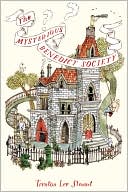
Book Review: The Mysterious Benedict Society by Trenton Lee Stewart
This charming book, around roughly 500 pages, is a fabulous read for middle-grade kids. It’s got adventure, warmth, mystery, villains, heroes, and much more. On one level, it’s a story of good vs. evil, but it’s also a delightful story of friendship and acceptance for those who are outcast and orphaned.
This is my favorite paragraph: “And yet, in these last days, he’d become friends with people who cared about him, quite above and beyond what was expected of him. With perfect clarity he remembered Reynie saying, ‘I need you here as a friend.’ The effect of those words, and of all his friendships, had grown stronger and stronger, until—thought he couldn’t say why he didn’t feel mixed up now—at the most desperate moment yet, he knew it to be true. There was bravery in him. It only had to be drawn out” (p. 421).
What is wonderful about this paragraph and about the situation as a whole is that the friends realize they are brave only because they want to help each other. They aren’t brave on their own or because they want to save themselves. They are brave for others. What a great lesson in self-sacrifice!
The other thing that I love, in addition to the themes of friendship and courage in the book, is the author’s use of language. In nearly every paragraph, or at least once per page, I felt myself inwardly nodding and saying, “Yes, that is the exact, perfect word in that sentence.” One of the things that, in my opinion, shows a book is hum-drum or only so-so in quality is the lack of originality and freshness in language, and the lack of precise vocabulary. But precise, concise, carefully chosen language creates fabulous fiction and perfect prose. So, for example, instead of using the word “walked” to show Constance moving down the hallway, Stewart writes that “Constance came tottering after her… (429). Instead of shouting, Mr. Curtain “barks” his commands. This attention to detail in word choice shows not only careful writing, but also savvy editing.
A delightful read for the whole family—check it out today!
Monday, January 17, 2011
Poetry Monday: Just for Fun
This morning, while doing some morning writing practice, I came upon this blog: The Miss Rumphius Effect, that has a weekly poetry stretch. This week's challenge is a poem about shoes. Thank you for this poetry challenge! :)
Here is my entry:
Barefoot Day
Toes, toes, attached to feet:
Our first hello to those we meet.
Slender, stubby, and hairy too—
but these toes of mine are hidden from you.
We cover them up with sneakers and crocks,
we dress them in knee-hi’s, slippers, and socks.
What are we hiding? Why do we fear?
Let’s all go barefoot one day of the year.
Bunions, and corns, and warts: beware!
Your day is coming; you’d better prepare.
Let’s scrub those piggies and pumice that heel—
It’s time, oh feet, for your big reveal!
©2011 Julie Stiegemeyer
Here is my entry:
Barefoot Day
Toes, toes, attached to feet:
Our first hello to those we meet.
Slender, stubby, and hairy too—
but these toes of mine are hidden from you.
We cover them up with sneakers and crocks,
we dress them in knee-hi’s, slippers, and socks.
What are we hiding? Why do we fear?
Let’s all go barefoot one day of the year.
Bunions, and corns, and warts: beware!
Your day is coming; you’d better prepare.
Let’s scrub those piggies and pumice that heel—
It’s time, oh feet, for your big reveal!
©2011 Julie Stiegemeyer
Sunday, January 16, 2011
Kids and Books: Promoting Literacy at your School or Library
One of the most meaningful events that can promote literacy in your school or library is to bring in an author for a visit. Hearing the author's "story behind the story" can generate excitement and enthusiasm among students. When I visit schools, I often find that kids get "fired up" about writing their own stories and reading more after hearing how I've gone through the process of having my books published. I focus on how everyone has a story to share, and I try to give kids the tools to work through the writing process to create the best possible version of the story.
I've visited schools at various times. Sometimes I have presented in connection to a student authors program. Many schools have special events when students write their own stories and even publish them and make them available for purchase. Those are great times to bring in an author or illustrator. Also, authors can come in connection with Dr. Seuss's birthday (at the end of February) or for a summer reading kick-off at the end of the school year. You can create an exciting event to motivate the kids to gain a love of reading and writing.
The focus of my presentations is usually on how to capture ideas, write about them, refine them, revise, and then finally produce a clean, polished draft. I show lots of photos of how my stories have gone from the idea stage to publication. Illustrators also go through the process of revision, so I spend time showing how some of the artwork in my books went through drafts as well. Since I am not an illustrator, I tend to spend more time on the language, but I also love looking into the artwork and showing how picture books need both the language and the art to work in beautiful concert together.
I share lots of photos and visual aids to help support what the students are learning in the classroom about the writing process and how to revise their projects. If you would love to promote writing and reading with your school or library, consider hosting an author for a visit.
For more info on my school visits, click here.
Thursday, January 13, 2011
Picture Book Reading Challenge - First 5
So my first five books for the reading challenge I picked at random from the shelves of the new picture books at the Elmhurst library.
Book #1/120 - The Rabbit Problem written and illustrated by Emily Gravett (Simon & Schuster, 2009).
The first one, The Rabbit Problem appealed to me because I have read and enjoyed Emily Gravett's books before. Her website is extremely cool. The back of the book says: "This book is based on a problem that was solved in the 13th Century by the Mathematician Fibonacci, but it is NOT (I repeat NOT) a book about math. It is a book about rabbits...Lots of rabbits!"
It actually is a book about math, that is, the Fibonacci sequence of numbers. (I had to look it up on Wikipedia, which says that his goal was to create a sequence in which each number is the sum of the previous two numbers). How Gravett frames the idea is very clever: she creates a family of adorable rabbits and shows the sequence of numbers on the months of a calendar. So, in January, there is one lonely rabbit (0 + 1). Then, February has a pair (1+1). March shows two baby rabbits, plus the couple, and so on. There are cool little interactive elements on each month (an invitation, a newspaper, etc.).
In my opinion, it is one of those kids' books that a child reader would flip through for 1.3 seconds and then set aside. It would definitely take a teacher or a parent explaining what is happening on the pages to help the child understand its significance. However, the artwork is charming and the concept is intriguing.
Book #2/120 - Pecan Pie Baby by Jacqueline Woodson and illustrated by Sophie Blackall (G.P. Putnam's Sons, 2010).
Love this gentle treatment of the feelings of jealousy and uncertainty of an older child expecting a new baby in the house. My favorite part about the book is the language--so kid-friendly, so authentic. Woodson refers to "jacket weather" instead of October and this I love: "Upstairs, I got that teary, choky feeling." Isn't that just how it feels? "Choky"?
Book #3/120 - The Princess and Her Panther by Wendy Orr, illustrated by Lauren Stringer (Beach Lane Books, 2010).
I'm getting to know the Beach Lane list fairly well, and I love it. It feels familiar, like the books I write and hope to write. Wendy Orr wrote Nim's Island, and Lauren Stringer also published Winter is the Warmest Season with Beach Lane, which I love.
The strength of this book is the more-than-meets-the-eye story of two girls camping out in their backyard one night. It delves so nicely into the imagination of children, that world they slip into so easily. The text is spare, and while I loved the concept, the language, in my opinion, might have been a bit more interesting. The refrain, for example, is fairly simple: "The princess was brave and the panther tried to be." Maybe a rhyme or clever turn of phrase could have spiced this up a bit more. However, I do like how the girls solve their own problem with a nice story arc and climax.
Book #4/120 - Chick 'n' Pug written and illustrated by Jennifer Sattler (Bloomsbury, 2010).
So adorable! So clever! Love this book! The main character, Chick, loves to read about the adventures of Wonder Pug and then finds his very own Wonder Pug to befriend. Warm, charming characters, easy language, clever concept, and funny climax. It's got everything!
Book #5/120 - Just One Bite by Lola Schaefer, illustrated by Geoff Waring (Chronicle, 2010).
My first nonfiction pick! The subtitle is: "11 Animals and Their Bites at Life Size." It reminds me a bit--though the link may be a stretch--of a cool book (and now I can't remember the title or find it) which examines one square foot of ground, on the surface, a bit lower, and still lower into the earth to show what lives in this one spot. If anyone knows the book I'm thinking of, will you comment, please?
Anyway, Just One Bite shows the size of the food that animals in increasing size eat. For example, Schaefer begins with a worm. A speck of dirt the size of the head of a pin is the meal of a worm: "With just one scoop, a worm can eat...this much dirt (and everything in it)!" Then the animals move up in increasing size, until finally we see how much food a sperm whale eats. Clever idea that I think would interest kids.
So, there we have it--my first five!
Book #1/120 - The Rabbit Problem written and illustrated by Emily Gravett (Simon & Schuster, 2009).
The first one, The Rabbit Problem appealed to me because I have read and enjoyed Emily Gravett's books before. Her website is extremely cool. The back of the book says: "This book is based on a problem that was solved in the 13th Century by the Mathematician Fibonacci, but it is NOT (I repeat NOT) a book about math. It is a book about rabbits...Lots of rabbits!"
It actually is a book about math, that is, the Fibonacci sequence of numbers. (I had to look it up on Wikipedia, which says that his goal was to create a sequence in which each number is the sum of the previous two numbers). How Gravett frames the idea is very clever: she creates a family of adorable rabbits and shows the sequence of numbers on the months of a calendar. So, in January, there is one lonely rabbit (0 + 1). Then, February has a pair (1+1). March shows two baby rabbits, plus the couple, and so on. There are cool little interactive elements on each month (an invitation, a newspaper, etc.).
In my opinion, it is one of those kids' books that a child reader would flip through for 1.3 seconds and then set aside. It would definitely take a teacher or a parent explaining what is happening on the pages to help the child understand its significance. However, the artwork is charming and the concept is intriguing.
Book #2/120 - Pecan Pie Baby by Jacqueline Woodson and illustrated by Sophie Blackall (G.P. Putnam's Sons, 2010).
Love this gentle treatment of the feelings of jealousy and uncertainty of an older child expecting a new baby in the house. My favorite part about the book is the language--so kid-friendly, so authentic. Woodson refers to "jacket weather" instead of October and this I love: "Upstairs, I got that teary, choky feeling." Isn't that just how it feels? "Choky"?
Book #3/120 - The Princess and Her Panther by Wendy Orr, illustrated by Lauren Stringer (Beach Lane Books, 2010).
I'm getting to know the Beach Lane list fairly well, and I love it. It feels familiar, like the books I write and hope to write. Wendy Orr wrote Nim's Island, and Lauren Stringer also published Winter is the Warmest Season with Beach Lane, which I love.
The strength of this book is the more-than-meets-the-eye story of two girls camping out in their backyard one night. It delves so nicely into the imagination of children, that world they slip into so easily. The text is spare, and while I loved the concept, the language, in my opinion, might have been a bit more interesting. The refrain, for example, is fairly simple: "The princess was brave and the panther tried to be." Maybe a rhyme or clever turn of phrase could have spiced this up a bit more. However, I do like how the girls solve their own problem with a nice story arc and climax.
Book #4/120 - Chick 'n' Pug written and illustrated by Jennifer Sattler (Bloomsbury, 2010).
So adorable! So clever! Love this book! The main character, Chick, loves to read about the adventures of Wonder Pug and then finds his very own Wonder Pug to befriend. Warm, charming characters, easy language, clever concept, and funny climax. It's got everything!
Book #5/120 - Just One Bite by Lola Schaefer, illustrated by Geoff Waring (Chronicle, 2010).
My first nonfiction pick! The subtitle is: "11 Animals and Their Bites at Life Size." It reminds me a bit--though the link may be a stretch--of a cool book (and now I can't remember the title or find it) which examines one square foot of ground, on the surface, a bit lower, and still lower into the earth to show what lives in this one spot. If anyone knows the book I'm thinking of, will you comment, please?
Anyway, Just One Bite shows the size of the food that animals in increasing size eat. For example, Schaefer begins with a worm. A speck of dirt the size of the head of a pin is the meal of a worm: "With just one scoop, a worm can eat...this much dirt (and everything in it)!" Then the animals move up in increasing size, until finally we see how much food a sperm whale eats. Clever idea that I think would interest kids.
So, there we have it--my first five!
Tuesday, January 11, 2011
Picture books go high-tech...some thoughts
I attended a conference about 10 years ago in which Harold Underdown spoke about i-Books. He told us how this would be the next big thing and that publishers would be shying away from paper-and-ink book publishing. Everyone in the room gasped and subsequently fell into an inevitable depression. However, picture books are still being published with paper, ink, and all of the traditional materials.
Yes, the economy and possibly the rise of iPads and Nooks capturing that interactive, cool, technologically advanced version of books has led to fewer picture books being printed. But they're still around and publishers are still buying new manuscripts.
So here are my random thoughts on this issue that could affect reading for kids and parents. An article from the New York Times features the color Nook's e-reader.
Recently, I was able to view a children's book on my friend's Nook. It was cool. The colors were vibrant and the story still endearing. I also had a chance to look at the interactive elements of a children's book on an iPad.
As a mom, I wonder how many parents would feel about their little ones handling their expensive equipment, like an iPad. I get nervous when my 15-year-old needs to borrow my laptop (yes, I am a bit paranoid, but he also has a habit of dropping things, stepping on earphones, etc.), so how much more would I feel anxious about a preschooler with sticky fingers and a drippy nose handling my iPad? It's one thought that comes to mind. However, the interactive nature of the illustrations and text is very cool. I would definitely sit there and play around with the ticking clock or read-aloud text, and I could see parents really enjoying sharing these resources with their kids.
The other thought I have about e-Readers comes from my experience in reading a recent book for adults on my husband's Kindle, the e-Reader produced by Amazon. At first, I felt totally out of my element. I was pushing buttons on this foreign contraption and just couldn't get used to the fact that I was reading an actual book. As I got into the story, it became more natural. I liked the fact that I could adjust the font size easily, but I guess that normally I must do a lot of flipping around when I read a paper book. I read the info about the author, I flip ahead to see how long the chapter is, I look at the chapter headings. This is not so easy with an e-Reader.
But, on the pro side of the argument, you no longer need bookmarks.
An editor recently told me about a children's book called "It's a Book" by Lane Smith. Love it, love it, love it! One character is reading an actual paper book, and an annoying, slightly ignorant character keeps asking what it is. What does it do? Where's the plug? It's a great story, with a bit of commentary on our cultural obsession with gadgets.
So, I guess the bottom line for me is that I don't think picture books in their traditional form will be going away any time soon. There's still a physical connection we have with stories and with page turns and the story--literally--unfolds. But I also love technology and have my own love of gadgets, so I can see parents embracing this new "delivery system" of books as well. My husband, who has owned a Kindle for a couple of years, uses it occasionally, and also reads regular books. Not all books are available on the Kindle, and he still goes to the library to check out books as well. This is what I picture parents doing. They may have a couple of books on their iPads to share with their kids, but will also make those library and bookstore runs for books as well. As an author, I think the possibilities are exciting, and I hope someday to see one of my books on an iPad or Nook!
Yes, the economy and possibly the rise of iPads and Nooks capturing that interactive, cool, technologically advanced version of books has led to fewer picture books being printed. But they're still around and publishers are still buying new manuscripts.
So here are my random thoughts on this issue that could affect reading for kids and parents. An article from the New York Times features the color Nook's e-reader.
Recently, I was able to view a children's book on my friend's Nook. It was cool. The colors were vibrant and the story still endearing. I also had a chance to look at the interactive elements of a children's book on an iPad.
As a mom, I wonder how many parents would feel about their little ones handling their expensive equipment, like an iPad. I get nervous when my 15-year-old needs to borrow my laptop (yes, I am a bit paranoid, but he also has a habit of dropping things, stepping on earphones, etc.), so how much more would I feel anxious about a preschooler with sticky fingers and a drippy nose handling my iPad? It's one thought that comes to mind. However, the interactive nature of the illustrations and text is very cool. I would definitely sit there and play around with the ticking clock or read-aloud text, and I could see parents really enjoying sharing these resources with their kids.
The other thought I have about e-Readers comes from my experience in reading a recent book for adults on my husband's Kindle, the e-Reader produced by Amazon. At first, I felt totally out of my element. I was pushing buttons on this foreign contraption and just couldn't get used to the fact that I was reading an actual book. As I got into the story, it became more natural. I liked the fact that I could adjust the font size easily, but I guess that normally I must do a lot of flipping around when I read a paper book. I read the info about the author, I flip ahead to see how long the chapter is, I look at the chapter headings. This is not so easy with an e-Reader.
But, on the pro side of the argument, you no longer need bookmarks.
An editor recently told me about a children's book called "It's a Book" by Lane Smith. Love it, love it, love it! One character is reading an actual paper book, and an annoying, slightly ignorant character keeps asking what it is. What does it do? Where's the plug? It's a great story, with a bit of commentary on our cultural obsession with gadgets.
So, I guess the bottom line for me is that I don't think picture books in their traditional form will be going away any time soon. There's still a physical connection we have with stories and with page turns and the story--literally--unfolds. But I also love technology and have my own love of gadgets, so I can see parents embracing this new "delivery system" of books as well. My husband, who has owned a Kindle for a couple of years, uses it occasionally, and also reads regular books. Not all books are available on the Kindle, and he still goes to the library to check out books as well. This is what I picture parents doing. They may have a couple of books on their iPads to share with their kids, but will also make those library and bookstore runs for books as well. As an author, I think the possibilities are exciting, and I hope someday to see one of my books on an iPad or Nook!
Monday, January 10, 2011
The Writer's Work: Not Lonely!
Do you have this stereotype about writers? We live off on our own, drinking cup after cup of coffee, hair sticking out in weird directions. We're stubbing out cigarettes on a messy desk, and the trash can is overflowing with crumpled up drafts. We're a bit strange, a bit odd, doing so much darn thinking all of the time. We might hang out at a coffee shop, but we definitely would not talk to anyone. Any of this sounding familiar?
I don't know if I'm a typical writer. Most likely not. I write for kids (for the most part), so the stereotype of the frustrated, caffeinated, tobaccoed writer doesn't really fit--at least it doesn't fit me.
But the lonely, isolated part? That definitely isn't me. Yes, I do spend time alone and enjoy it. I need room to think, and quiet in which to think it. But one of the best thing about writers is our community. We need each other. We need advice, moral support, critiquing, and lots of it.
So, I'm excited that tomorrow I'm getting together with a group of children's writers in my area for a critique group. We plan on meeting regularly to critique each other's work, and tomorrow is our launching party. In what ways has the writing community helped other authors?
I don't know if I'm a typical writer. Most likely not. I write for kids (for the most part), so the stereotype of the frustrated, caffeinated, tobaccoed writer doesn't really fit--at least it doesn't fit me.
But the lonely, isolated part? That definitely isn't me. Yes, I do spend time alone and enjoy it. I need room to think, and quiet in which to think it. But one of the best thing about writers is our community. We need each other. We need advice, moral support, critiquing, and lots of it.
So, I'm excited that tomorrow I'm getting together with a group of children's writers in my area for a critique group. We plan on meeting regularly to critique each other's work, and tomorrow is our launching party. In what ways has the writing community helped other authors?
Saturday, January 08, 2011
The Writing Life
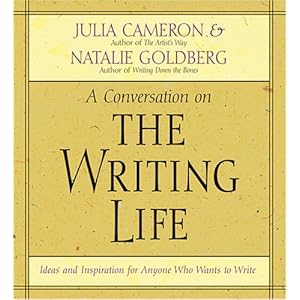
The Writing Life is an audio recording of a conversation with Julia Cameron and Natalie Goldberg, both writers and writing teachers. After owning this for many months, I finally popped it in my CD player in the car and found it to be an incredibly inspirational resource.
Julia Cameron is one of my favorite writing inspirations. She is probably most famous for The Artist's Way or its follow-up Vein of Gold. But I love her book The Right to Write. She considers herself an artist and doesn't allow herself to be pigeon-holed as a writer or screenwriter or poet or musician. But I find that her book on writing is the most helpful and has the closest correlation to what I need.
She speaks a great deal about morning pages--three pages in long hand written every morning. This is a writing practice which gets you in the process of writing so that when you have time to sit down and work on your projects, you are not overly concerned about the marketability of the work. You just write. It's the way to get the "censor off your shoulder." While I'm not completely successful at this, I do try to stick to a writing regimen in that I write in my journal at least several times a week. This is writing just for me, not to sell, not to share. It keeps me connected to the page.
Natalie Goldberg is most well-known for her book Writing Down the Bones, another book on writing and the writing life. I'm not as familiar with her work, but I know many other writers who love it.
This audio CD is a conversation between these two authors and a moderator. In the first part, the three sit down and talk in a studio, and in the second part, they discuss writing in front of a studio audience. It's a highly motivational and inspirational CD that I recommend to any writer, wherever they are in their writing journey--whether published or not. Check it out!
Julia Cameron is one of my favorite writing inspirations. She is probably most famous for The Artist's Way or its follow-up Vein of Gold. But I love her book The Right to Write. She considers herself an artist and doesn't allow herself to be pigeon-holed as a writer or screenwriter or poet or musician. But I find that her book on writing is the most helpful and has the closest correlation to what I need.
She speaks a great deal about morning pages--three pages in long hand written every morning. This is a writing practice which gets you in the process of writing so that when you have time to sit down and work on your projects, you are not overly concerned about the marketability of the work. You just write. It's the way to get the "censor off your shoulder." While I'm not completely successful at this, I do try to stick to a writing regimen in that I write in my journal at least several times a week. This is writing just for me, not to sell, not to share. It keeps me connected to the page.
Natalie Goldberg is most well-known for her book Writing Down the Bones, another book on writing and the writing life. I'm not as familiar with her work, but I know many other writers who love it.
This audio CD is a conversation between these two authors and a moderator. In the first part, the three sit down and talk in a studio, and in the second part, they discuss writing in front of a studio audience. It's a highly motivational and inspirational CD that I recommend to any writer, wherever they are in their writing journey--whether published or not. Check it out!
Friday, January 07, 2011
Picture Book Reading Challenge
Thanks to a fellow kid-lit writer, I just learned about a challenge to read 12, 36, 72, 120, or 200 picture books over the course of 2011. I love the idea of this challenge because it is so important to read, read, read in whatever genre you hope to write. One reason this helps writers is because we learn what is working and what isn't as effective. We also can learn about new genres and many other things. My goal is to read at least 10 picture books each month, which will total no fewer than 120 for 2011. I'm not going to promise to post on every book, but will maybe post on a grouping of them once a month.
Join me in my reading journey!
Thursday, January 06, 2011
A great resource for children's writers
If you are a children's writer and you do not belong to THE ONLY professional organization for kid-lit writers, you need to join today. The organization is the Society of Children's Book Writers and Illustrators. Here's the link to the national site. Here is the link to the local SCBWI-Illinois chapter. And here is the latest Prairie Wind journal, published by the SCBWI-IL. Great info! Great tips! Read and enjoy.
Friday, December 31, 2010
Plotting and Structure
Over the last few weeks, I've been pondering plotting and structure. In November, I went to the annual Prairie Writers' Day, hosted by the Illinois SCBWI chapter. One of the speakers discussed the importance of looking at your book--whatever length--in terms of its plot and structure. She used this classic diagram to help describe how structure works in an effective story.
I've read some great books over the years on this very topic, including my favorite (modestly titled): How to Write a Children's Picture Book by Eve Heidi Bine-Stock. In this book, Bine-Stock describes the necessity of looking at pacing and the "beats" a repeated phrase or refrain can lend to a book. She does so by examining classic picture books, like The Carrot Seed by Ruth Krauss and Bill Martin Jr.'s Chicka Chicka Boom Boom and shows how they work effectively through their structure.
For example, each story is expressed in what she calls acts, like in the acts of a play. A "three-act book" would work in this way:
Act 1 - Introduce character and conflict
Act 2 - Show developing conflict, leading to its ultimate climax
Act 3 - Quick denoument, resolving the conflict
The great thing is that any story can easily fit into this format. Even a saga like Tolkein's Lord of the Rings could be broken down in this way:
Act 1: Introduction of Frodo, the ring, the conflict--the great need to destroy it
Act 2: The journey of getting to Mount Doom to destroy the ring, rising to the climax of its destruction
Act 3: The restoration of Middle Earth, the coronation of the king, the departure of Frodo
Of course, in this trilogy, Act 2 comprises most of the text, with mini stories (with beginnings, middles, and endings) throughout the rising action. For example, their journey through the Mines of Moria is a mini story, within the larger plot of the book.
All of this is in the back of my mind because I am currently working on a project with a very short word count, which would be a young picture book. I imagine this targeting the 2-4 year old range. The stories focus on a toddler who begins to learn how to solve his own problems. What is so much fun for me is to see how short they can be, while still preserving that natural story arc. I'm striving for no more than 400 words total, and telling three little stories in which each one has its own beginning, middle, and ending, with the character figuring out how to solve his own problems. It's been a fun and challenging project, which is almost ready for submission.
I've read some great books over the years on this very topic, including my favorite (modestly titled): How to Write a Children's Picture Book by Eve Heidi Bine-Stock. In this book, Bine-Stock describes the necessity of looking at pacing and the "beats" a repeated phrase or refrain can lend to a book. She does so by examining classic picture books, like The Carrot Seed by Ruth Krauss and Bill Martin Jr.'s Chicka Chicka Boom Boom and shows how they work effectively through their structure.
For example, each story is expressed in what she calls acts, like in the acts of a play. A "three-act book" would work in this way:
Act 1 - Introduce character and conflict
Act 2 - Show developing conflict, leading to its ultimate climax
Act 3 - Quick denoument, resolving the conflict
The great thing is that any story can easily fit into this format. Even a saga like Tolkein's Lord of the Rings could be broken down in this way:
Act 1: Introduction of Frodo, the ring, the conflict--the great need to destroy it
Act 2: The journey of getting to Mount Doom to destroy the ring, rising to the climax of its destruction
Act 3: The restoration of Middle Earth, the coronation of the king, the departure of Frodo
Of course, in this trilogy, Act 2 comprises most of the text, with mini stories (with beginnings, middles, and endings) throughout the rising action. For example, their journey through the Mines of Moria is a mini story, within the larger plot of the book.
All of this is in the back of my mind because I am currently working on a project with a very short word count, which would be a young picture book. I imagine this targeting the 2-4 year old range. The stories focus on a toddler who begins to learn how to solve his own problems. What is so much fun for me is to see how short they can be, while still preserving that natural story arc. I'm striving for no more than 400 words total, and telling three little stories in which each one has its own beginning, middle, and ending, with the character figuring out how to solve his own problems. It's been a fun and challenging project, which is almost ready for submission.
Wednesday, December 29, 2010
The simple joys of work
Yesterday, our plumber came over to take a look at the drains in our upstairs bathroom and the garage. After he cleared out the bathtub drain and watched the water going down, he said, "Look at that great swirl!" The water was moving so fast down the drain that it created that familiar little vortex when the pipes are wide open.
It got me to thinking about those little joys we have in our day when our work pays off, when we see results, like the water swirling down a bathtub drain.
So, I thought I'd list some of my favorite "pay-offs" from a good day's work.
- a clean, shiny kitchen sink
- an empty dishwasher
- a well-stocked refrigerator
- clean laundry neatly folded in dresser drawers (can you tell I'm catching up on my housework?)
- a box of books, newly published, with my name on the cover
There are so many small joys in the course of our days that sometimes we overlook. Take time to think about your little payoffs, like the swirling water down the drain and cherish the blessings of work. What are some of your simple joys?
It got me to thinking about those little joys we have in our day when our work pays off, when we see results, like the water swirling down a bathtub drain.
So, I thought I'd list some of my favorite "pay-offs" from a good day's work.
- a clean, shiny kitchen sink
- an empty dishwasher
- a well-stocked refrigerator
- clean laundry neatly folded in dresser drawers (can you tell I'm catching up on my housework?)
- a box of books, newly published, with my name on the cover
There are so many small joys in the course of our days that sometimes we overlook. Take time to think about your little payoffs, like the swirling water down the drain and cherish the blessings of work. What are some of your simple joys?
Tuesday, December 21, 2010
Justice and Hope
I've decided that it's time to read a book on Martin Luther King, Jr., not only because of his worthy cause of social and racial equality, but because I want to immerse myself in his incredible use of language, imagery, and persuasion.
I recently heard a quote that he paraphrased from its original, which I'd never heard before. (How did I miss this all my life?) The MLK quote is about the moral arc of the universe, though long, ultimately bending toward justice, which is paraphrased from the original by Theodore Parker in the 1850s: "I do not pretend to understand the moral universe; the arc is a long one, my eye reaches but little ways; I cannot calculate the curve and complete the figure by the experience of sight; I can divine it by conscience. And from what I see I am sure it bends towards justice." (Apparently, there has been some controversy over the origin of the quote, which you can read about here.) I love this image of the moral arc of the universe. And I say yes to it--though it may be a slow fight, justice will ultimately succeed. That is what we hope, isn't it?
Natural law, deep within human nature, fights against injustice in the world. We've all had that experience when we hear about an injustice and our immediate response is: "It's not fair!" Kids are great at this. They demand equal treatment. Siblings must get the same gift, the same treatment, etc. But adults are good at it too. When friends hurt us or treat us as we don't deserve, when an employer shows favoritism, or when we are punished for things we didn't do, we too rail against the unfairness of it all. We demand justice.
On this Christmas week, I am thinking about Dr. King, moral arcs of the universe, justice, and a situation that was not fair at all. A baby, a manger, a young pregnant woman--shut out in the bitterness of that Christmas night. What would it take to right the wrongs in the universe? What would it take to fix the injustice of it all?
It would take an infant, a small, helpless infant to bring us back to God. It would take a sacrifice to fix us, broken, hurting, and in need of restoration. It would take someone to heal the broken and to balance the injustice. It would take a child who would become a man to seek the suffering and take that suffering to the cross to ultimately bring about what is good and whole. It would take Jesus.
That man did not deserve a painful, humiliating death. It was not fair, but it was perfect. It was not just, but it was good. God, the author of justice, the maker of goodness, knew just what we needed: a Savior, who came, wrapped in swaddling clothes, a baby crying in the night. What we received was perfect love, forgiveness, and hope from this unassuming child, tucked away in a Bethlehem stable. That moral arc of the universe bent toward the stable on that Christmas night. We got something better than justice: we got what we did not deserve. Thanks be to God!
Thursday, December 16, 2010
Picture Books live on!
A few weeks ago, The New York Times printed a front-page article stating that picture books were on their way out for good. There were lots of irritated authors, publishers, agents, librarians, teachers, parents, etc. who disagreed with much of the content. Apparently, some of those quoted in the article felt their comments were taken out of context. So, I really appreciated this nice article from Publishers Weekly with a response. Bottom line: just because The New York Times says it's so doesn't mean it is.
Monday, December 13, 2010
Book review
Here's a book review featuring a couple of my books on Christian Book.com by Chris Anderson.
Saturday, December 11, 2010
Various movie reviews
So, here are some movies I've watched recently and my random thoughts on them:
The Road with Viggo Mortensen, the fabulous king-in-hiding in the Lord of the Rings trilogy. On the surface, this could be the most depressing movie ever made. It's set in a post-apocalytic world, where all of the trees are either a) on fire, b) dead, or c) randomly exploding and/or falling down. No animals exist. Food is scarce. Most of the population is dead. We don't know what causes this armageddon, but it's bad...real bad. So, Viggo is the father and he and his son are wandering through this wilderness, trying to survive. I promise. I will never, ever take green grass or standing trees for granted again. Or food.
Okay, so on the surface it's totally depressing. It's bad. But then, I thought about it a bit more, and with Viggo as a Christ figure it makes a lot more sense. There seems some purpose to it. He gives up everything in order to make sure the child is cared for. So, while it's a pretty bleak picture, there is some hope. A father cares for his son--no matter what. And when the inevitable happens at the end, his sacrifice gives the son everything he needs.
Lessons learned: Don't take grass for granted. Enjoy canned pears. Keep a stash of emergency food in a bomb shelter. Know that life has purpose.
Knight and Day with Tom Cruise and Cameron Diaz. This movie is cute. It's a light spy-thriller movie with lots of fun little humorous elements. Pop some popcorn and enjoy.
Lessons learned: Life gets serious. Goof around a little bit.
This next movie, A Perfect Getaway, was a perfect surprise! This seemed like the average thriller/suspense movie, but it actually had so many interesting twists and turns in the plot that I was totally engrossed. Sometimes with a little persistence, you can find those gems while mining through the boring rock pile of average movies. (There is some bad language in this movie, so parents of young 'uns should be aware.)
Lessons learned: Don't judge a movie cover by the thousands of others made like it that suck pretty bad.
Also, I watched The Beach with Leonardo DiCaprio recently. This one is a bit (okay, more than a bit) bizarre. There's some supernatural-ish stuff going on, as well as some hippie commune stuff, some pretty nasty violence and a beautiful, perfect beach. Eh...probably not worth it, but the images and the concept behind it were kind of cool. Everyone longs for that perfect beach getaway. (This one is definitely not for kids.)
Lessons learned: It's probably not a good idea to get off the beaten path when traveling in Thailand.
For those of you who know me fairly well know that I have never really liked horror movies. But when I had the opportunity to go with my husband, my son, and my son's girlfriend to see Paranormal Activity 2, I decided to suck it up and do it. Spoiler alert: Freakiest scene #1: in the kitchen when the cabinets open (those of you who have seen it know what I'm talking about). Freakiest scene #2: when the baby starts being sucked out of his crib. Not good. The good news is that I didn't have nightmares, and didn't even get freaked out until some (literal) bumps in the night woke me up. Weirdly, these movies scare my husband and son more than me.
Lessons learned: Don't make pacts with the devil. Seriously. Don't.
So, those are the ones I can think of recently. Any good ones you've seen lately?
The Road with Viggo Mortensen, the fabulous king-in-hiding in the Lord of the Rings trilogy. On the surface, this could be the most depressing movie ever made. It's set in a post-apocalytic world, where all of the trees are either a) on fire, b) dead, or c) randomly exploding and/or falling down. No animals exist. Food is scarce. Most of the population is dead. We don't know what causes this armageddon, but it's bad...real bad. So, Viggo is the father and he and his son are wandering through this wilderness, trying to survive. I promise. I will never, ever take green grass or standing trees for granted again. Or food.
Okay, so on the surface it's totally depressing. It's bad. But then, I thought about it a bit more, and with Viggo as a Christ figure it makes a lot more sense. There seems some purpose to it. He gives up everything in order to make sure the child is cared for. So, while it's a pretty bleak picture, there is some hope. A father cares for his son--no matter what. And when the inevitable happens at the end, his sacrifice gives the son everything he needs.
Lessons learned: Don't take grass for granted. Enjoy canned pears. Keep a stash of emergency food in a bomb shelter. Know that life has purpose.
Knight and Day with Tom Cruise and Cameron Diaz. This movie is cute. It's a light spy-thriller movie with lots of fun little humorous elements. Pop some popcorn and enjoy.
Lessons learned: Life gets serious. Goof around a little bit.
This next movie, A Perfect Getaway, was a perfect surprise! This seemed like the average thriller/suspense movie, but it actually had so many interesting twists and turns in the plot that I was totally engrossed. Sometimes with a little persistence, you can find those gems while mining through the boring rock pile of average movies. (There is some bad language in this movie, so parents of young 'uns should be aware.)
Lessons learned: Don't judge a movie cover by the thousands of others made like it that suck pretty bad.
Also, I watched The Beach with Leonardo DiCaprio recently. This one is a bit (okay, more than a bit) bizarre. There's some supernatural-ish stuff going on, as well as some hippie commune stuff, some pretty nasty violence and a beautiful, perfect beach. Eh...probably not worth it, but the images and the concept behind it were kind of cool. Everyone longs for that perfect beach getaway. (This one is definitely not for kids.)
Lessons learned: It's probably not a good idea to get off the beaten path when traveling in Thailand.
For those of you who know me fairly well know that I have never really liked horror movies. But when I had the opportunity to go with my husband, my son, and my son's girlfriend to see Paranormal Activity 2, I decided to suck it up and do it. Spoiler alert: Freakiest scene #1: in the kitchen when the cabinets open (those of you who have seen it know what I'm talking about). Freakiest scene #2: when the baby starts being sucked out of his crib. Not good. The good news is that I didn't have nightmares, and didn't even get freaked out until some (literal) bumps in the night woke me up. Weirdly, these movies scare my husband and son more than me.
Lessons learned: Don't make pacts with the devil. Seriously. Don't.
So, those are the ones I can think of recently. Any good ones you've seen lately?
Monday, December 06, 2010
Happy St. Nicholas Day!
I hope you are all enjoying your chocolate coin cookies or whatever other goody that may have been left in your shoe this morning! I wrote about the story of St. Nicholas because of a suggestion from a close friend of our family, Todd Peperkorn. About 12 years ago (or so) at a Christmas party, we were discussing St. Nicholas. "Why isn't there a story about the real St. Nicholas?" we wondered. That little conversation, as well as my own thinking and learning about Nicholas, the Bishop of Myra, led me to put together his story in a book called Saint Nicholas: The Real Story of the Christmas Legend, published by Concordia Publishing House.
The thing, of course, that is remarkable about Nicholas was his wonderful generosity, and what a wonderful virtue that is to promote--on Dec. 6, at Christmas, and all year long.
Friday, December 03, 2010
The tricky balance...
...between pursuing creative ventures that might earn a paycheck and those that definitely do. These days, I am finding myself knee-deep in grading English composition papers without much time for writing. I'm frustrated, but working and earning actual money. So, I find myself asking the question: is it better to have the financial security or the extra time to pursue those free-lance projects that may or may not pay off.
The good news is that when teaching writing, I can give back. I can share what I've learned from writing instructors through the years. I can give the gift of sharing my experiences with others.
The not-so-good news is that I'm not progressing as quickly as I'd like to with the 5 or 6 projects on my writing to-do list.
I liked this image because the rocks balance each other out. So, maybe I have a couple of weeks when all I'm doing is lecturing, grading, and answering student emails. But hopefully that will be balanced out by some time after Christmas to write and be more creative.
But, it's all a gift, and I'm thankful for the opportunities I have to work--in whatever form that may take.
Saturday, November 27, 2010
Guilty much too often of this...
...not of blowing up cars. That would be illegal. And probably dangerous.
But I am guilty of what this writer refers to as "bore-geous" writing. Writers, and whoever else works with words, read this. Now.
Ayelet Waldman discusses the importance of avoiding pointless beautiful writing. She emphasizes how important it is to move the plot forward with each scene, each sentence, each word, and when it doesn't, cut it. It's hard to let go of my "babies"--those favorite scenes, characters, stories, whatever that don't really do much of anything.
It's so true! Let's get some action happenin!
Subscribe to:
Posts (Atom)